
In the book Plenty Alisa Smith and J.B. Mackinnion chronicle their journey of one year eating the 100-mile diet. The book's website has a "getting started guide" to help you start the local food challenge. Eating locally isn't necessarily "better" for the environment. There are many factors that go into the environmental footprints that your food makes. The production methods, processing, travel and method of travel, etc. It is true that often local food is more environmentally friendly and sustainable for several reasons:
Small farmers often focus on producing food organically and chemically free even if they don't pay for the organic label.
Food travels less distance to get to you. Keep in mind the distances a farmer might travel delivering food all over a county or the distance you may drive to get from the farmer market to the grocery store, etc.
Eating locally usually requires eating seasonally, which prevents extra food miles, and harsh preservation methods such as freezing.
When purchasing food from local producers it is easier to get in contact with them and learn about their methods of production first hand. Don't expect better standards automatically from local producers, always ask. Farmers that are proud of their work will be happy to talk to you about it.
Monday, March 24, 2008

Thursday, February 28, 2008
Fair Shares
Sarah Hale and Jamie Choler have started a company called Fair Shares which is a combined CSA system. In other words, they provide a variety of fresh local produce and meats from different local farms into one box for the shareholders. Learn more about it in this article from STLtoday.
article provided by Bryan
article provided by Bryan
Monday, February 11, 2008
Burning Kumquat in action

I helped the burning kumquat with their handouts. They broke the earth for the first time this past Saturday. This isn't the final artwork they went with, but I am posting it for informational purposes.
Wednesday, January 30, 2008
You'll eat it, and you'll like it!
 As Americans celebrated New Year's by tearing into a juicy steak or enjoying several alcoholic beverages, this time next year they might be in for a surprise about their culinary hedonism. Recently, the US Food and Drug Association surprised few when it announced animal byproducts, mainly meat and dairy, can be sold to consumers without any notification that it was the byproduct of laboratory cloning. There are many arguments against selling and consuming animal byproducts but the most fact-based is comparing the genetic composition of the cloned animals to their 'organic' counterparts.
"In 2002, researchers at the Whitehead Institute for Biomedical Research in Cambridge, Massachusetts, reported that the genomes of cloned mice are compromised. In analyzing more than 10,000 liver and placenta cells of cloned mice, they discovered that about 4% of genes function abnormally. The abnormalities do not arise from mutations in the genes but from changes in the normal activation or expression of certain genes." (source)
For any carnivore/omnivore out there, this is just one of a long list of reasons why you should take steps to eliminate meat from your diet.
article by John O.
Sunday, January 27, 2008
Rethinking the Meat-Guzzler
This article from the New York Times by Mark Bittman discusses the costs of meat production and the possibility for reducing production or creating a healthier system of production. I didn't find the article mindblowing, but there were a few good data examples such as
An estimated 30 percent of the earth’s ice-free land is directly or indirectly involved in livestock production, according to the United Nation’s Food and Agriculture Organization, which also estimates that livestock production generates nearly a fifth of the world’s greenhouse gases — more than transportation.
And some nice info-graphics for graphic art nerds such as myself:
 I do have a few issues with the article because of statements such as, "And would the world not be a better place were some of the grain we use to grow meat directed instead to feed our fellow human beings?". Although has it's heart in the right place, it is not considering all of the facts: The world produces more than enough food for all of the earth's population. Also, he mentions that increasing production of grain-fed cattle increases the need for grain production. In the Omnivore's Dilemma, Pollan suggested that highly subsidized excess corn production was a cause for feeding livestock with grain rather than with their natural food source grass, because the meat could be produced more cheaply* on less land. In other words, excessive amounts of corn created excessive amounts of cheap livestock not the other way around.
Read the article here for yourself.
* - cheaply is a relative term that doesn't include cost of subsidies or environmental costs
An estimated 30 percent of the earth’s ice-free land is directly or indirectly involved in livestock production, according to the United Nation’s Food and Agriculture Organization, which also estimates that livestock production generates nearly a fifth of the world’s greenhouse gases — more than transportation.
And some nice info-graphics for graphic art nerds such as myself:
 I do have a few issues with the article because of statements such as, "And would the world not be a better place were some of the grain we use to grow meat directed instead to feed our fellow human beings?". Although has it's heart in the right place, it is not considering all of the facts: The world produces more than enough food for all of the earth's population. Also, he mentions that increasing production of grain-fed cattle increases the need for grain production. In the Omnivore's Dilemma, Pollan suggested that highly subsidized excess corn production was a cause for feeding livestock with grain rather than with their natural food source grass, because the meat could be produced more cheaply* on less land. In other words, excessive amounts of corn created excessive amounts of cheap livestock not the other way around.
Read the article here for yourself.
* - cheaply is a relative term that doesn't include cost of subsidies or environmental costs
Tuesday, January 22, 2008
Bon Appetit green issue
Check out Bon Appetit's February "The Green Issue." You can't borrow mine, I drooled all over the pages with recipes. There are some great articles in there from the best eco-friendly restaurants in the country (unfortunately there wasn't one in St.Louis mentioned), a listing of in season fruits and veggies, to an article called "Why I'm not a vegetarian."
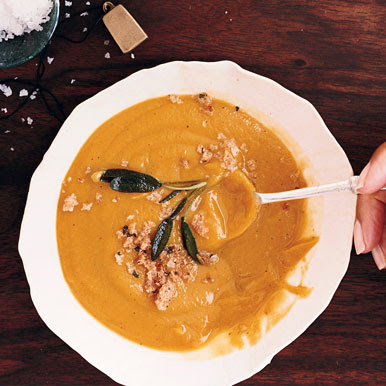
Here are some recipes that were featured in the magazine. (click the name for the link)
 who doesn't love pancakes?
Monday, January 14, 2008
Eggs as Nature intended
 So I went to Colorado over my winter break and my brother brought us two kinds of eggs, the best eggs according to him that he could find at his grocery store (right) and eggs from his chickens on the farm he lives on. It's part of his job to let the chickens out at the crack of dawn and back in the evening. The color difference remarkable but the real litmus test is the taste. I personally could taste a difference, but I didn't have a preference. This might be because I was sick, or because I am so used to eating eggs from chickens that aren't getting the proper treatment. My dad and brother said the farm eggs were better. I suggest taste testing for yourself sometime. I really like the eggs I have bought at the Soulard farmer's market, which I assume are from local family farms.
Subscribe to:
Posts (Atom)