
I found this article in which Mike Coupe director of Sainsbury's, one of the UK's leading grocery stores, in response to a statement about reducing consumption as the only viable way to cut carbon emissions said "Managing needs versus demand seems like a form of communism," he said. "It's something the world we are living in isn't ready for." This statement is not surprising coming from someone who makes his money off of people buying surpluses of food that they never use. How true is this? Are people not ready to reduce their consumption?
Just from the recent price jumps in gas, people are in mass finally shying away from excessively large cars and getting on waiting lists for hybrids. So, how far do you have to push people before they reduce their consumption? The world didn't have the problem of extreme excess production 200 years ago. When food was industrialized in the early 20th century produced in extreme excess, we provided too much food for the consumer. This made obesity eventually a national epidemic. I can't see why it should be a problem to reduce food consumption. People lived perfectly happily for thousands of years before they had the choice of Cheetos or Fritos or Doritos or Tostitos. At what point will we realize that maybe the health of the nation and the environment is more important that making this crap food that helps line the corporations pockets. It's a natural response to eat what is in front of you, and with this lining our shelves, how are we supposed to resist?
Ok, so it's viable to say maybe people are not ready to reduce consumption. But I firmly believe that mass production, leads to mass consumption.
Showing posts with label reading recommendations. Show all posts
Showing posts with label reading recommendations. Show all posts
Tuesday, June 24, 2008

Friday, April 25, 2008
Where are the mid-size farms?
In an article from Grist, Hole in the Middle, Tom Philpott suggests that the insignificance of real sustainable food available in the US is due to a lack of a market for mid-size farms, that could conceivably provide a reasonable amount of food that small farms simply cannot produce. This was an interesting article, but I wish the author had speculated more about how to possibly create this market that was an alternative between farmer's markets and corporate national grocery chains. He suggested that local movements are the main efforts attempting to salvage these farms. Because the mid-size farms already lose money on the production of their food crops, they do not have the means to invest in restaurants etc. What if there were governmental policies that supported these farms instead of massively subsidizing corn, depleting any revenue for mid-scale farmers?
Thank you Zach S. for the article.
Thank you Zach S. for the article.
Monday, March 24, 2008
Plenty
In the book Plenty Alisa Smith and J.B. Mackinnion chronicle their journey of one year eating the 100-mile diet. The book's website has a "getting started guide" to help you start the local food challenge. Eating locally isn't necessarily "better" for the environment. There are many factors that go into the environmental footprints that your food makes. The production methods, processing, travel and method of travel, etc. It is true that often local food is more environmentally friendly and sustainable for several reasons:
Small farmers often focus on producing food organically and chemically free even if they don't pay for the organic label.
Food travels less distance to get to you. Keep in mind the distances a farmer might travel delivering food all over a county or the distance you may drive to get from the farmer market to the grocery store, etc.
Eating locally usually requires eating seasonally, which prevents extra food miles, and harsh preservation methods such as freezing.
When purchasing food from local producers it is easier to get in contact with them and learn about their methods of production first hand. Don't expect better standards automatically from local producers, always ask. Farmers that are proud of their work will be happy to talk to you about it.
Small farmers often focus on producing food organically and chemically free even if they don't pay for the organic label.
Food travels less distance to get to you. Keep in mind the distances a farmer might travel delivering food all over a county or the distance you may drive to get from the farmer market to the grocery store, etc.
Eating locally usually requires eating seasonally, which prevents extra food miles, and harsh preservation methods such as freezing.
When purchasing food from local producers it is easier to get in contact with them and learn about their methods of production first hand. Don't expect better standards automatically from local producers, always ask. Farmers that are proud of their work will be happy to talk to you about it.
Sunday, January 27, 2008
Rethinking the Meat-Guzzler
This article from the New York Times by Mark Bittman discusses the costs of meat production and the possibility for reducing production or creating a healthier system of production. I didn't find the article mindblowing, but there were a few good data examples such as
An estimated 30 percent of the earth’s ice-free land is directly or indirectly involved in livestock production, according to the United Nation’s Food and Agriculture Organization, which also estimates that livestock production generates nearly a fifth of the world’s greenhouse gases — more than transportation.
And some nice info-graphics for graphic art nerds such as myself:
 I do have a few issues with the article because of statements such as, "And would the world not be a better place were some of the grain we use to grow meat directed instead to feed our fellow human beings?". Although has it's heart in the right place, it is not considering all of the facts: The world produces more than enough food for all of the earth's population. Also, he mentions that increasing production of grain-fed cattle increases the need for grain production. In the Omnivore's Dilemma, Pollan suggested that highly subsidized excess corn production was a cause for feeding livestock with grain rather than with their natural food source grass, because the meat could be produced more cheaply* on less land. In other words, excessive amounts of corn created excessive amounts of cheap livestock not the other way around.
Read the article here for yourself.
* - cheaply is a relative term that doesn't include cost of subsidies or environmental costs
An estimated 30 percent of the earth’s ice-free land is directly or indirectly involved in livestock production, according to the United Nation’s Food and Agriculture Organization, which also estimates that livestock production generates nearly a fifth of the world’s greenhouse gases — more than transportation.
And some nice info-graphics for graphic art nerds such as myself:
 I do have a few issues with the article because of statements such as, "And would the world not be a better place were some of the grain we use to grow meat directed instead to feed our fellow human beings?". Although has it's heart in the right place, it is not considering all of the facts: The world produces more than enough food for all of the earth's population. Also, he mentions that increasing production of grain-fed cattle increases the need for grain production. In the Omnivore's Dilemma, Pollan suggested that highly subsidized excess corn production was a cause for feeding livestock with grain rather than with their natural food source grass, because the meat could be produced more cheaply* on less land. In other words, excessive amounts of corn created excessive amounts of cheap livestock not the other way around.
Read the article here for yourself.
* - cheaply is a relative term that doesn't include cost of subsidies or environmental costs
Tuesday, January 22, 2008
Bon Appetit green issue
Check out Bon Appetit's February "The Green Issue." You can't borrow mine, I drooled all over the pages with recipes. There are some great articles in there from the best eco-friendly restaurants in the country (unfortunately there wasn't one in St.Louis mentioned), a listing of in season fruits and veggies, to an article called "Why I'm not a vegetarian."
Here are some recipes that were featured in the magazine. (click the name for the link)
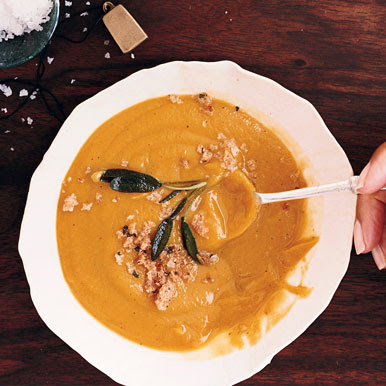
 who doesn't love pancakes?
Thursday, December 6, 2007
The Farm Bill
The Farm Bill is a very important piece of legislation for anyone interested in the topic of food and the environment. Lizzy provided a link to the Chef's Collaborative that contains an article which has compiled resources to learn more about the Farm Bill.
Why should chefs care about the Farm Bill? Read all about the
implications ofthis big piece of legislation and how it could
impactchefs’ abilities to purchasethe local and sustainable
ingredients they value.
Thursday, November 15, 2007
The Vertical Farm
 Currently, over 80% of land suitable for raising crops is in use.* Columbia Professor Dr. Dickson Despommier believes that skyscrapers designed for urban farming are a solution that will allow reforestation of current farmland, and local production and distribution of food to urban areas. Read about the project in this article, or at the project's website.
*source: The Vertical Farm Essay
The Omnivore's Dilemma
I just bought The Omnivore's Dilemma by Michael Pollan, which I'm sure many of you have already heard about.
Wikipedia summarizes the book:
Pollan explores the question What should we have for dinner? To answer this question, he follows four meals from three different food chains from their origins to the plate. Along the journey Pollan examines the ethical, political, and ecological factors that are intertwined in the industrial, organic, and personal (hunted-gathered) food chains, while describing the environmental and health consequences that result from our food choices within these chains. The book describes the shades of meaning related to the term organic.
sounds exciting!
Wikipedia summarizes the book:
Pollan explores the question What should we have for dinner? To answer this question, he follows four meals from three different food chains from their origins to the plate. Along the journey Pollan examines the ethical, political, and ecological factors that are intertwined in the industrial, organic, and personal (hunted-gathered) food chains, while describing the environmental and health consequences that result from our food choices within these chains. The book describes the shades of meaning related to the term organic.
sounds exciting!
Subscribe to:
Posts (Atom)
